Vendor Risk
SOC 2 Vendor Intake Review
Review vendor SOC 2 reports, policies, and supporting documentation against your internal control requirements. Reduce manual intake time and surface gaps faster.
01 — Operational Trigger
Security teams spending weeks on vendor SOC 2 review
Security and vendor risk teams receive SOC 2 Type II reports as part of vendor onboarding and periodic review cycles. Each report requires manual analysis against internal control requirements, trust service criteria coverage, exception handling, and subservice organization dependencies. As the vendor portfolio grows, this becomes a significant operational burden with inconsistent documentation.
02 — Why Manual Review Slows Decisions
SOC 2 reports are long, dense, and inconsistently structured
A typical SOC 2 Type II report runs 60–200 pages and includes auditor opinions, management assertions, system descriptions, control testing results, and often dozens of complementary user entity controls. Reviewers must identify what the vendor actually controls, map it to internal requirements, assess testing exceptions, and document gaps — across multiple concurrent reviews without a standardized workflow.
03 — Workflow Complexity
Coverage varies significantly by vendor and scope
Not all SOC 2 reports cover the same trust service criteria. A vendor may hold Security and Availability but not Confidentiality. Subservice organizations may carve out controls that are material to your use case. Without a structured intake process, coverage gaps and untested complementary controls go undetected until escalation.
04 — How Tiebreaker AI Structures Evidence
Map vendor controls to your internal requirements
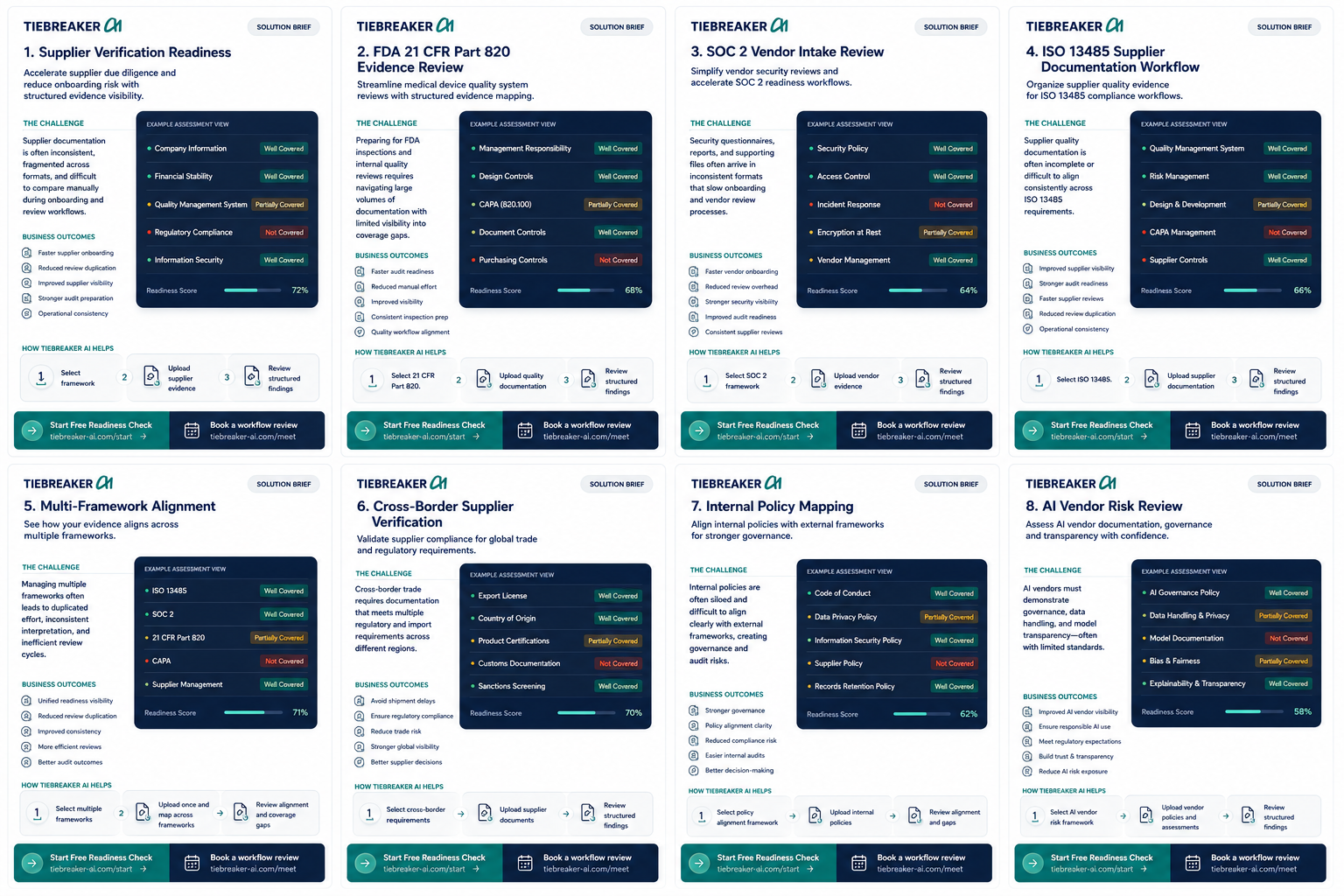
Upload the vendor SOC 2 report, supplemental policies, and any supporting documentation. Select the applicable framework — SOC 2 trust service criteria or an internal control baseline. Tiebreaker AI maps vendor documentation against selected controls, surfaces what is well covered, partially covered, or not covered, and flags gaps in complementary user entity control coverage. Each vendor is reviewed in a scoped project context.
05 — What Teams Can See Faster
Faster exception identification and coverage gap analysis
Teams can identify testing exceptions, carve-outs, and coverage gaps without reading every page manually. This allows security reviewers to focus their time on gaps that require follow-up documentation or vendor engagement rather than comprehensive document search.
06 — Expected Operational Outcome
Consistent vendor risk documentation across the portfolio
Security teams achieve a repeatable intake workflow that produces consistent, documented coverage analysis for every vendor. Reviewers spend less time on initial document search and more time on decisions. The vendor risk portfolio maintains a current, structured readiness view as annual SOC 2 reports are renewed.
Ready to structure your vendor intake workflow?
Select a framework, review the sample project, or upload a redacted vendor document set to explore the workflow.